2020

So, I’m slightly late, but I decided to make a post about last year, and what I want from this year.

2019 was a bit of a positive year for me. It was difficult, personally, with some things that have been going on in real life, but I think for my art it was a bit better. I have a terrible perfectionism problem. Even with fics. But I was able to make a little bit of progress on it last year. I started writing True Sound, and did several chapters of An Unconventional Union already with Yan. I also wrote several more chapters than are currently released.

But, if you look at the amount of posts I’ve made here, and on my Tumblr…It’s not many. I experimented more, prototyped…But I didn’t do nearly enough finished works. I was still so bogged down trying to make it “good enough” and being bothered by how 3d it looked. Because of that, I didn’t finish much, even though I wanted to. I’m frustrated with myself for that. I want to do more. I want to be better and show my art and ideas, too. I tried last year to beat that stupid perfectionism, and I progressed, but it’s still there.

This year, I want to kill it. To make a lot more, and post a lot more, without worrying so much if it’s not perfect, or how NPR or 2d-looking it is. Those are my goals, but if I spend so much time trying to get one perfect thing, what will I have to show for myself? One thing.

Another thing I want to work on is my energy. I find for some reason, I’m frequently low on energy. It makes it difficult to do anything, and with the internet and such in easy reach, it’s too easy to end up vegging out for hours. Part of it is because I’m off my antidepressants, I’m sure. But I need to knuckle down and make myself focus, and, again, push that perfectionism aside. I have fics I want to write, and art to make. It won’t do itself. Though I’m told I should also take more breaks, too, rather than being constantly in a mindset of thinking I’m meant to be working. I find it difficult to relax these days. I hate it. I can’t seem to switch off, but being switched on doesn’t mean I’m in the right mindset or have enough energy. It’s like being awake enough that you’re not asleep, but too tired to move.

Still, I am trying. To prove that, I have some work in progress images to show. I started a Ryou model the other day. After spending a few hours, I was able to make his face and upper body. He also has a lower body, but, as per usual, it’s trash. I’m very, very poor at legs and waists. I invested in some videos about sculpting and anatomy that I need to watch to learn more, and get more references.

It’s extremely rough at the moment. I started out sculpting him a bit aimlessly. I’m not sure exactly what I’m doing with his face. I know that I want faces on my Yugioh art to be stylised in some way, but I’m not quite sure how, so I’m just trying to go with what I like.

Now that I look at it, the side is very squished. That’s not right at all.

I think the look I’m going for is sort of psuedo anime? Slightly stylised proportions and shape, but keeping some realistic elements, like realistic anatomy and proportions, and features like noses, rather than more common anime kinds like noses stylised to points, or, on very stylised or chibi characters, that sort of snout-shaped face.

Looking at Yugi’s hair as an example, I don’t think Yugioh characters would adapt to a totally realistic style very well. If he was rendered in complete realism, his hair would destroy it by looking unnatural as hell. It just isn’t how realistic hair looks or works, especially elements like the red edges to it; that could, maybe, be styled as his hair becoming redder at the ends or something, but that wouldn’t hold up from multiple angles. So, I think a semi-realistic style at most is best for him and the other Yugioh characters I want to make models of.

My other problem is that Ryou is very slim. I’m used to doing more muscular characters to learn anatomy, so I’ve made him far too fit just by default. I need to slim him right down until he looks suitably bishonen, haha. But truly, this model is, in its current state, embarrassingly bad. I didn’t reference a lot so far, partly because I couldn’t be bothered and partly because I was in the zone when I was doing it and didn’t want to kill my momentum. So it has lots of problems, like the terrible waist that has no hips, the weird shape from the side, the back being altogether horrible, the lack of ribs and serratus, which I basically flattened to oblivion because they were horrible…He’s too broad, to boot, and too narrow from the side.

I wanted to just power through it before I lost momentum by stressing about those, but I really should correct them before sculpting more on him. If he’s missing landmarks and correct muscle placement, it won’t look better when it’s slim and smoothed; it’ll only be blobby.
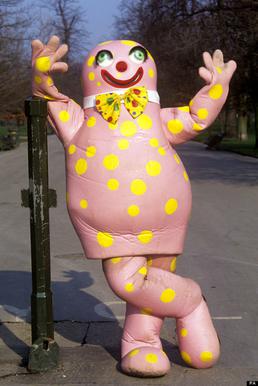
At least he won’t be this Blobby.

It’s really horrible to me, so far. Some work can fix it, and I’m going to try that. Yan encouraged me to show more wips and all, so I’m trying that. I want to show more of them as the year progresses, too. I’d like to get more skilled and able to finish them better and more quickly, though.

Still, this is something, at least. And when I put it through 3DCoat’s basic renderer, it doesn’t look entirely terrible with shading. There’s a lot to fix, but it exists, at least. And this as it stands, even when corrected, should be a far cry from how he’ll look with my shaders and NPR techniques.

So, I think I am making progress. Baby steps, maybe, but still, progress. I want to post more this year, so hopefully I’ll post some updates soon as I progress on him. I want to make a Ryou basemesh to derive our au-versions from, and do the same for other characters as well.

For now, I’ll just try and work on it when I have time, and try to push those negative thoughts out of my mind.

Frustration

Recently, I’ve been frustrated with my shaders.

None of them look the way I want them to. I’d like to achieve a painterly appearance, or watercolour, but they’re quite elaborate. I sometimes think it would be better if I could settle for cel shading, but I just can’t accept that. Or rather, I want to be able to do more than just shade everything so simply. I’m not one of those people who’s interested in NPR primarily, or purely, to replicate the style of anime. It’s not that I look down on that style; it’s just not my preference.

So, I’ve been doing more research, as usual. The big problem with using Fresnel or Layer Weight to make the rough shape of the object, or an outline, is that it can give unwanted lines, and does. I dislike having to manually correct these, so I’ve been trying to think of ways to fix this. I’ve experimented the day or so with blurring the normals of the model to remove details.

How did I do this? Well, I’m not blurring the normals, exactly. I came across this video a while back. One of the features demonstrated is creating a false blur by distorting a texture.

23:58 for the blur technique.

I’d hoped I could apply the same technique straight to the normals, but it didn’t work. Instead, I baked the object’s original normals out to an image, and used that method to distort it.

The result was effective, actually. I haven’t removed anything from the default Suzanne head, but by blurring it and using it as the Normal input, it’s removed the detail. It also darkened it for some reason, which I was able to compensate for by remapping the value by an equal amount to the distortion. I’d hoped to use this to get a blurred version of Fresnel I could use to make a better silhouette. However, when I tried it..

It only works from the front. I really don’t know why this is. My best guess is that it’s something to do with the normals’ texture. The colours don’t appear the same way when I look at them as the original normals do, so perhaps it’s a reason why it doesn’t display right. However, when I used it as the normals without blurring, it displayed correctly.

It’s quite frustrating. But at least I learned I can blur out detail with this method. That’ll likely come in useful.

The advantage of this method is that the original normals are a texture that isn’t being permanently modified, so it can be controlled as I please.

The disadvantage is, it’s grainy. I haven’t found a way to smooth it yet, though, for what I’m doing, a bit of grain may help it appear natural. Also, as it’s just using the original normals from a texture, it can’t be modified the way the real normals of the geometry can.

On another note, I came across an interesting method for modifying shading.

This technique comes up ~ 1 hour, 15 minutes in.

This one uses an image texture to paint on to control shading. The trick is to create a UV slot on the objects you want to modify, and then use the UV Project modifier to project UVs, like the Project From View UV mapping option, but in real time. Then, have an image texture using that UV to control the shading by adding or subtracting. As they’ll all reference the same image, you don’t need to select individual objects to control, and can modify everything in the shot at once.

The advantage of this method is that you can control them all at once as long as they’re referencing the texture. Additionally, if you make it the same resolution as your render – and you probably should – it shouldn’t appear pixelated. And since it’s an image, you could also edit it externally if you really needed to or wanted to. I find this method far more responsive as I paint than modifying vertex paint, and it can be far more precise than vertex paint would be on most sensible meshes. It’s extremely effective for cel shading.

The disadvantages are several. For one, it’s an image, so it’ll bloat your file size, potentially a lot if you’re rendering at high resolution. Also, because it’s an image, you can’t animate it the same way you could the vertex paint method; you’d have to use an image sequence, increasing the file size further and manually repainting each frame. Although, if replicating anime, that may be best, as it’s essentially what colouring in anime is like, and leaves room for human errors that make it appear more genuine. Lastly, if you change anything in the shot, you’ll have to repaint. Depending on the change, this can be small or large; if you move the camera, you’d have to redo the lot, or, if you were just panning, perhaps you could compensate using the Mapping Node or translation method. That makes it tricky if you want to change the camera angle or re-pose a character or such, though if you modify the shading last, it shouldn’t be as much of an issue. It’s also more difficult to make look natural on something with smooth shading.

Overall, I find there are advantages and disadvantages to this method, but it’s certainly something I’ll keep in mind. I might well use it next time I’m doing a render; I prefer the flexibility of vertex paint, being able to modify things after the fact and the shading changes not be rendered all worthless…But the speed and precision of this texture method isn’t something I can ignore. Custom shading is very likely the key to convincing 2d, or at least an essential.

Anyway, that’s what my research and testing has turned up for the moment. I want to experiment more. Reading a reference from an old Siggraph paper, Painting With Polygons, Video Watercolorization using Bidirectional Texture Advection gave me some ideas; that’s actually where my idea to blur the normals came from. It also seems several steps of their process are ones I’d used in my earlier compositing technique, though applied differently. I’ll try experimenting more and see what I can turn up.

Shine

I haven’t posted here in a long time.

It’s not that I haven’t been doing anything, but I’m still struggling with perfectionism. I’ve also been spending less time on sculpting recently. I find I’m very conflicted. I often feel like nothing I do is going to be good enough. At other times, I feel like I can do whatever I set my mind and efforts to. What is good enough, I have to ask myself? When it looks like something you’d see on Artstation? I don’t even really like Artstation. There’s no doubt the people you see there are very skilled. But they’re not my kind of things. The 3d art shown there is mostly, from what I’ve seen, trying to be very realistic, and some of them are shockingly detailed, but….They don’t say anything. They just look good.

The art I’ve always admired, mostly, has been a lot more expressive. Impressionist art, rougher, looser styles, things that are more simplistic in some ways and prioritising feeling over pure accuracy to life. Dustin Nguyen and Hwei Lim’s art are examples of that to me; they’re not realistic at all, and can be rough, but they convey the feeling much better.

I can’t imagine their works would be better if they were replaced with more realistic styles. Plus, realism is generic. How do you put your own fingerprint on something that’s just copying reality? If you start to change things while being realistic, you’ll likely fall into the uncanny valley, I think, and have, in some ways, far less options for expression.

You couldn’t pull off Daisy’s expression like that with realism. (Giant Days)

I try to focus on things like these. Getting bogged down thinking that my art isn’t any good because it’s not realistic enough or something…It’s too easy. It’s a trap. I want to show my ideas and thoughts. I don’t have to be on the level of some absurdly skilled Artstation professional to do that. I don’t.

I’ve also been listening recently to a song by Garbage called Beloved Freak. For some reason, it really speaks to me. It seems to be about not fitting in with other people, but that you’re not wrong for that, and have value.

Sometimes we get so tired and weak

We lose the sky beneath our feet

You’re not alone

Recently, my mental health has gone back to being terrible. That’s part of why I haven’t sculpted recently. I hurt myself. I feel like everything is pointless. They wouldn’t be any good anyway, so why bother? That’s what I think at those times. Just to breathe can be an effort. I don’t fit in. I never will. And, as a trans woman, I’m constantly slapped in the face with that. A death by a thousand cuts. So many little wounds bleeding me out. It may sound pretentious, but it is how I honestly feel sometimes; that I’m just being killed very slowly.

My favourite part is at the end of the song.

“So here you stand, beloved freak
The world is at your feet
Here you stand, beloved freak
The world is at your feet

This little light of mine
I’m going to let it shine
This little light of mine
I’m going to let it shine
This little light of mine
I’m going to let it shine
Let it shine, let it shine, let it shine

And so you stand, beloved freak
The world is lying at your feet
There you stand, beloved freak
Let it shine, let it shine, let it shine.”

It makes me think. My art isn’t “normal”. It’s 3d that doesn’t want to do what 3d is considered to be “for”. Not to be as realistic as possible, or even look like 3d, or sell something, or anything like that. It’s not perfect, or highly detailed, and I don’t consider myself a good artist. I don’t seem to fit in well in reality, either.

But, I still have worth, no matter what my brain says when I’m going through bad times. I don’t want to die. I have my own light. Even if it’s dim and flickering. I can make what I want to make. It’s not pointless. It’s not bad. I can do what I want to do.

That’s what I believe on a good day, anyway.

3D Is Not Bad

I’ve been thinking recently about how I’ve been approaching 3d art, and perfectionism. I’ve know Millie for several years now, and we’ve been talking about headcanons and aus for quite a lot of that time. We’ve wanted to make things, and developed our stories quite a lot. But with my art, and plans to write fics, and in general show our versions myself and not just leaving it to her, I’ve always been tripped up by perfectionism.

At first, it was just realising that, upon taking it seriously, my skills were entirely lacking. Until I met her and we started developing things, my interest in 3d was quite casual; it was something I enjoyed, but didn’t work super hard on, and just played around, really. But that wasn’t enough for showing our versions of the characters, to me; they were deformed, lumpy, they had no recognisable anatomy, or little, and I didn’t know enough to rig them well enough, and, with their incorrect proportions, they wouldn’t look natural even if I could. I was also just using primitive NPR stuff back then, like cel shading and the inverted hull method of making outlines. Those aren’t necessarily bad, but they’re quite simple, and I found them generic; I wanted my art to look like mine, not something anyone could make.

But, as I continued, I ended up slipping without realising into a toxic mindset of nothing ever being good enough. Even if it was better than the last one, even if it looked about like what I wanted to show, it wasn’t sufficient. I’m still struggling with that. On top of that, I unintentionally sabotaged myself by making more work for myself. I didn’t like using basemeshes and such, so every time I made a character or something, I’d do it from scratch; the only thing I was really reusing were shader techniques I came up with. And that’s good for practice, but it makes it take a lot longer. I was, as a perfectionist, afraid that any errors on my base meshes would be replicated on anything made from it, and, being self-conscious of my art being 3d, and doing a lot to try and find ways to make it look more 2d, I wanted to do things from scratch more like 2d artists do, though at least I didn’t go as far as resculpting everything everytime I needed to make a render, at least.

The problem is, the longer I spend on something, the more likely I am to see the flaws. But, due to lack of motivation, or knowledge, or skill, or any other reason, I don’t resolve them quickly enough to be done with it an avoid seeing more, so I end up in a constant loop of seeing flaws and deciding I have to stop and fix those, then seeing more flaws. I become discouraged and start over, telling myself “This one, I will get right.” But I never do. I’m tired of that. I want to show what I can do. I want to show my style, and renders of the characters me and Millie have come up with together. I want to have things to show for myself, and pull my weight, and not just be saying I’ll do things without actually doing them. I want to be able to look back and see that I’ve done things, and feel good that they’re there, and try to do better next time.

So, I’ve started trying to change my mindset. Instead of thinking, “That’s not good enough.” I’m trying to think “I’ll do better next time I sculpt this, but I’ll use this for now.” And to take advantage of the fact that I’m doing 3d, instead of trying to make everything from scratch. I really want to get better.

At the moment, I’m working on chibi characters. I made a chibi base mesh a while ago, and rigged most of it using a Mesh Deform modifier, so I only have to make limited changes to make them into different characters. My current goal is to make a set of Ryous. I came across a technique while working on it that could allow me to do 2d eyes that can still be properly animated, whereas I’m currently using the method that uses an eye cavity. If I can work out how to adapt it to my chibis, I’d prefer to use 2d eyes, but I won’t let myself stop and investigate that right now. I need to finish things.

For now, I’m going to work on Ryou’s chibis, and make Mariku, Malik and Bakura ones, too.

Dragon Knights And Perfectionism

I’ve been having quite a problem making things for a while.

I like to sculpt, and work on new NPR techniques, and I want to show the ships and characters I like well, but in the end, I haven’t ended up posting anything in a long time. I ended up stuck in a crappy perfectionist mindset, always revising or redoing things, or procrastinating from them because I was afraid of getting it wrong, or that it wouldn’t be good enough. But because of that, I didn’t do anything. I don’t have anything finished to show for my sculpting and shaders. But I was encouraged by my friend recently to try and dial it back, and do simpler things and work my way up, and to try and work on my perfectionism, so I’m trying.

I’ve started with chibis. They’re a lot simpler to model and rig than realistically styled characters. I’ve also been finding they’re easier to shade, to an extent; it might be because they don’t have as many bulges and creases and things that can go wrong and look incorrect. Still, I wasn’t able to make them look the way I wanted them to yet. My shaders need more work.

But, I made something. It feels good to have done that, at least.

Millie and I were talking about our Mirror! AU, in which traits of Yugioh characters are reversed, resulting in very different relationships. Jounouchi and Kaiba (we call him Seto in that au, since he prefers to be friendly and warm) are friends, and we had a headcanon that Jounouchi and Seto game together. Millie also made a cute comic about it. It inspired me to imagine them playing an MMO or something together as Dragon Knights, similar to the Dragoons from Final Fantasy.

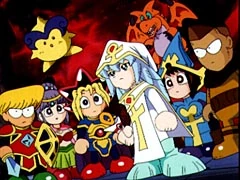
Since their signature cards in Yugioh are the Blue Eyes White Dragon (BEWD) and Red Eyes Black Dragon (REBD) I designed them to be reminiscent of those, and similar to the Monster World figures from the manga and Toei anime’s Monster World arc.

My design for Dragon Knights Seto and Jounouchi. I’m not a skilled 2d artist.

Then I modeled and rendered them. I’m not very happy with the render, but it’s something; I’ll have to play with their shaders some more, and learn to make environments. Even a very simple one, like the grass they’re standing in was unfamiliar to me. I’ve spent so long doing characters and being a perfectionist about them, I’ve neglected other areas.

I’m not very satisfied overall with it, but I’m glad I finally did something. I’m grateful to Millie for pushing me to do something like this. I’ll also make a post for myself about what’s currently going right and wrong with the shaders, and what I want to do to improve them. I’ll try and build momentum and make more things, too.